Evaluate a Klaviyo agency's results by checking the metric definition, measurement period, attribution settings, baseline and account context. Read revenue totals, revenue shares and reported growth separately. Ask what work changed and what remains unmeasured. Attributed revenue alone does not establish incremental sales or predict another brand's result.
On this page6 sections
Which metrics should you ask an agency to explain?
Ask which question each metric answers before comparing the number. Revenue helps describe scale; revenue per recipient helps examine a send's return across its audience. Neither replaces a view of deliverability, customer behavior or costs. Agree on definitions and data sources before using a monthly report to judge performance.
| Metric | Question it helps answer | Inputs to check | Limit |
|---|---|---|---|
| Email-attributed revenue | Which orders received credit under the reporting model? | Conversion event, interaction rules, attribution window, currency and period | Credit assigned to email does not establish sales caused by email |
| Email-attributed revenue share | How much reported store revenue was credited to email? | Same-period email revenue and total revenue; consistent scope | The share can move when other channels change |
| Revenue per recipient | How much attributed revenue was reported for the audience sent to? | Revenue numerator, recipient denominator, send type and period | Different segments and offers can change the result |
| Click and conversion rates | Are readers taking the intended action? | Metric definition, denominator, tracking and filtering | Rates from different systems may use different definitions |
| Deliverability and list health | Can the team keep reaching people who want the email? | Delivery, bounce, complaint and unsubscribe data over time | A revenue figure can hide deteriorating list health |
| Repeat purchases and profit | Are customers returning, and is the work economically useful? | Order cohorts, customer identity, product margin, discounts and service costs | These require data beyond a campaign attribution headline |
The final row describes evidence worth requesting when available. It is not a claim that HWM or every agency reports those measures for every account. Ask which data the proposed service can supply and which questions require a separate analysis.

What changes when attribution settings change?
Attribution assigns credit to interactions under defined rules. A report can therefore change when its conversion event, attribution window or interaction eligibility changes. Check the settings behind the report and record them with the period. Do not assume that two screenshots use equivalent settings because both came from Klaviyo.
Klaviyo's documentation explains message conversion tracking and attribution model settings. Use the current documentation and the account's settings for platform behavior. A case summary that omits those settings leaves part of the measurement unknown.
Incrementality asks how many sales would not have happened without the marketing. That needs a credible comparison, such as an appropriately designed holdout, with its assumptions and limitations explained. An attributed order or a before-and-after increase alone cannot answer the counterfactual question.
For a visual introduction to first-touch, last-touch and multi-touch concepts, see Klaviyo Academy's attribution explainer at the model overview. The video was published in 2023[1]; use it for the concepts, not as instructions for today's Klaviyo interface or defaults.
What do HWM's published cases show?
These cases are HWM's own published reports. The figures and implementation descriptions below come from the linked cases and original presentation material. They are not independently audited benchmarks, and the work column does not establish what caused the outcome.
| Account | Metric | Reported figure and source | Measurement period | Work described publicly |
|---|---|---|---|---|
| Furniture and clothing | Absolute email revenue | $3.4M[2] | A single fourth quarter | 8 flows, 4 core and 4 advanced; A/B-tested flow revisions |
| Japanese and Scotch whisky retailer | Email-attributed share of revenue | 57%[3] | Ninety days | 8 flows, 4 core and 4 advanced; focus on subscription sign-ups and churn |
| Personalized POD gifts | Email revenue lift | +380%[4] | Thirty days after launch | 8 flows, 4 core and 4 advanced; interest tags; tuned send times and formats |
| Streetwear and sneakers | Email-attributed share of revenue | 39%[5] | Three months | 8 flows, 4 core and 4 advanced; lifestyle segmentation and interest tags |
| Personalized gifts | Absolute email revenue | $1.1M[6] | BFCM and Christmas, approximately two months | Deliverability and list cleaning, holiday campaigns, post-purchase experience |
The furniture case's original overview identifies Q4 2022[7]. Keeping that date beside the result matters: a holiday-quarter total does not tell a buyer what an off-season month would produce. The whisky overview uses both a revenue share and a money total; they describe different aspects of the same case and should not be combined into a ranking.
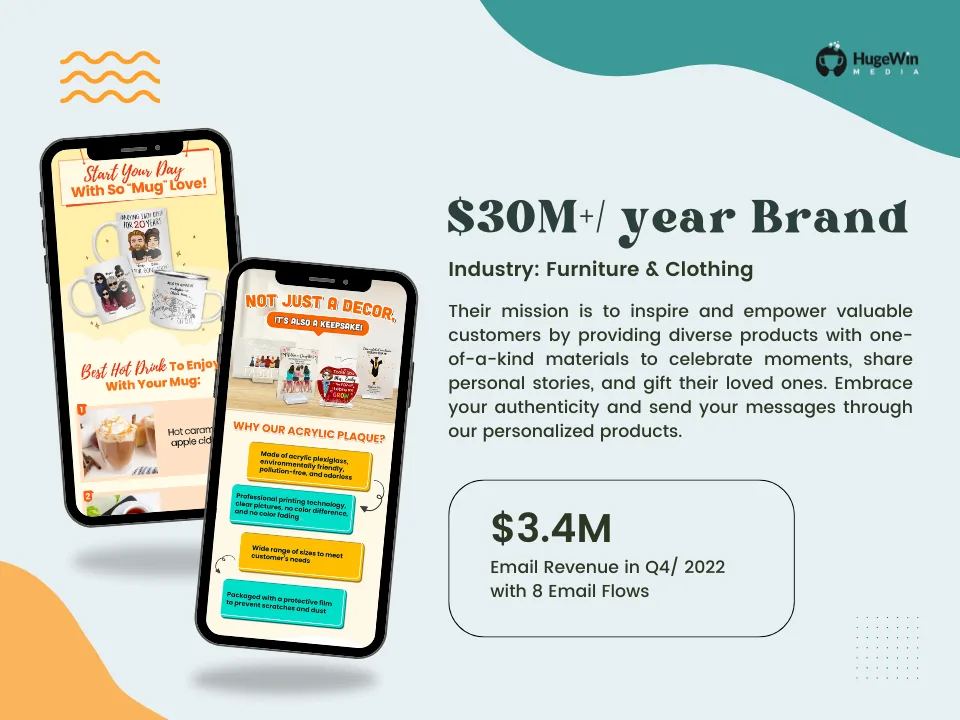
Read the full furniture and clothing case alongside the furniture teardown for the work described. The original overview above is agency-reported material, not evidence of incremental revenue.
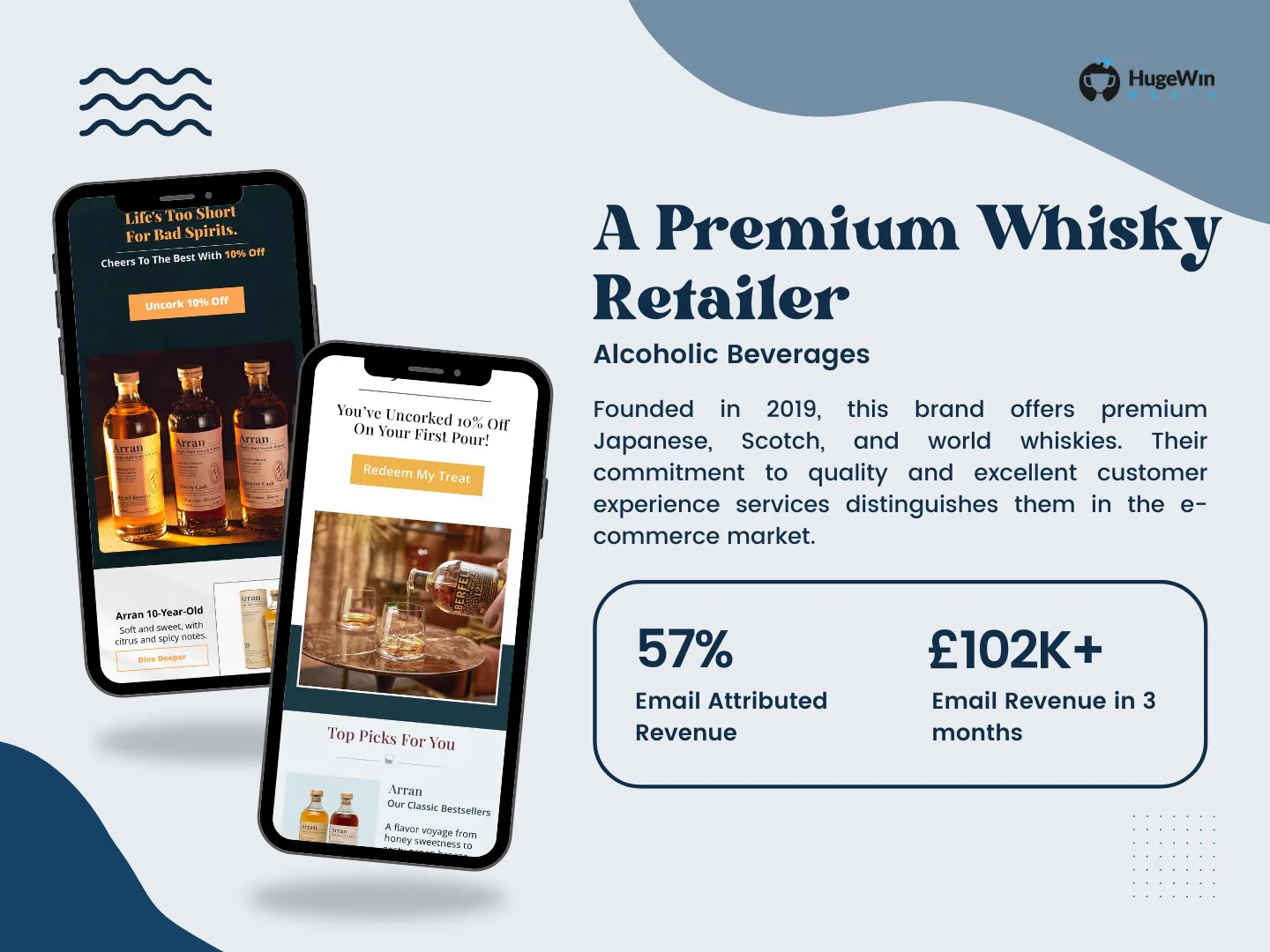
The whisky case provides context for the figures in this original overview. Keep its period, currency and attribution limits attached when using the case in a buying discussion.
What is missing from the comparison?
The public cases do not disclose a complete set of attribution settings, comparison baselines, margins and concurrent business changes for every result. Record those gaps. Do not fill them with assumptions about the agency's process or the customer's account.
| Case | What a buyer still needs to ask |
|---|---|
| Furniture and clothing | Which attribution rules and comparison period were used? How did the holiday quarter differ from an ordinary period? |
| Whisky retailer | What changed in store revenue and other channels while email's share changed? What attribution settings produced the report? |
| Personalized POD gifts | What was the baseline amount for the reported lift, and was the comparison window equivalent? |
| Streetwear and sneakers | What was total store revenue in the same period, and how was email credit assigned? |
| Personalized holiday gifts | How did promotions, demand and customer mix differ from the comparison period? |
The cases describe implementation alongside outcomes. You can use that detail to ask how the team works. None of these public summaries isolates the incremental contribution of each flow, design or campaign through a controlled comparison.
How should a buyer compare agency reports?
Put the source reports side by side and check their definitions before judging the difference. If the currency, period or attribution rules differ, ask for a comparable view. When the data cannot be aligned, explain the difference rather than presenting a league table.
A useful comparison sheet has a place for the source URL or export, report date, metric, denominator, attribution settings and business context. Add the changes made during the period and the limitations of the conclusion. A blank field is a follow-up request, not a reason to invent a value.
For deliverability, ask for the trend and the team's response to it alongside revenue. Klaviyo's deliverability monitoring guidance explains the platform's reporting context. A strong promotion can coincide with revenue growth and list-health problems, so ask how both affected the next decision.
Which questions should you take into the agency call?
- Can you show a relevant case and explain exactly what its result measures?
- Which measurement settings and period would you use in our reports?
- What starting conditions could make that case a poor comparison for our store?
- What data would let us assess repeat purchases, profit or incrementality, and what would remain unknown?
- Which work would you prioritize first, and what evidence would change that decision?
Use the agency evaluation worksheet to record the answers beside scope, team and fees. Browse the case library for the original examples, or book a free Klaviyo audit to discuss what to investigate in your account.
What to read next
Inspect the original cases and their source notes for the metric, period, currency and limitations behind each headline.
Use those findings in your agency evaluation, together with the proposed team, scope, reporting access and exit terms.
Sources
- Klaviyo Academy attribution video publication year
- Huge Win Media case study: $3.4M in Q4 email revenue for a $30M/year furniture & clothing brand
- Huge Win Media case study: JPHA whisky retailer: 57% email-attributed revenue
- Huge Win Media case study: +380% email revenue, $560K+ in 30 days for a personalized POD gifts brand
- Huge Win Media case study: 39% email attributed revenue, $489.4K in 3 months for a streetwear brand
- Huge Win Media case study: $1.1M BFCM email revenue for a $20M/year personalized gifts brand
- Furniture and clothing original overview: Q4 2022
